The landmark
Are the Arcos da Lapa worth a look before your night out?
The white aqueduct above the district: who built it, why it has two storeys of arches, and why a tram now crosses it.
Reserve my night ↗Quick answer
Yes, the Arcos da Lapa are well worth a few minutes before you head in for the evening. Wikipedia calls the structure the Carioca Aqueduct, inaugurated in 1750, and its Lapa stretch runs 270 metres on two storeys of 42 arches, up to 17.6 metres high. It is one of the most recognisable sights in Rio, and it stands in the same district as Rio Scenarium, so the walk takes in a piece of colonial engineering as well as a slice of city life. A tram has crossed it since 1896, which adds a little movement to the picture.
The aqueduct in brief
| What Wikipedia records | |
|---|---|
| Formal name | The Carioca Aqueduct, also known as the Arcos da Lapa |
| Opened | Inaugurated in 1750 to bring water from the Carioca River |
| Size | Two storeys of 42 arches, 270 metres long and up to 17.6 metres high |
| Design | By military engineer José Fernandes Pinto Alpoim, inspired by Lisbon's Águas Livres Aqueduct |
| Today | Carries the Santa Teresa tram, a viaduct since 1896 |
| Heritage | Listed by IPHAN in 1938 |
A city that needed water
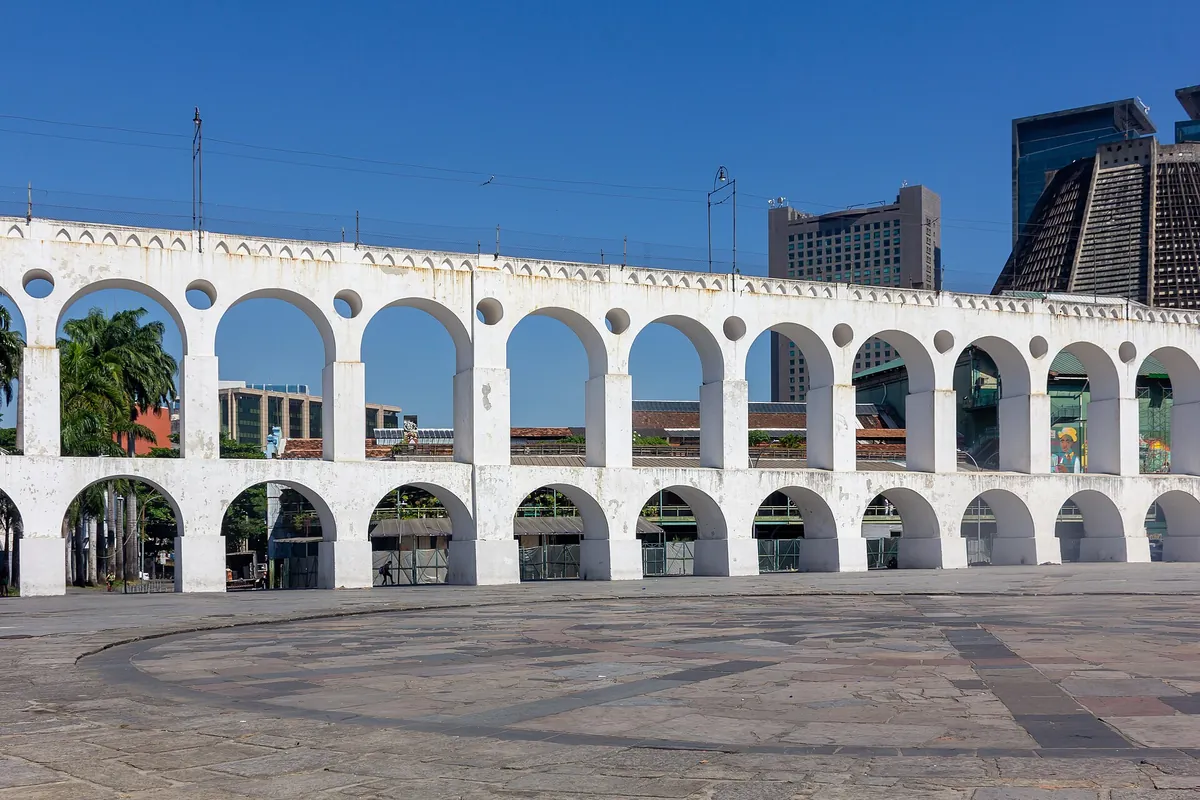
Wikipedia explains that early Rio was ringed by swamps whose water was poor, and that fresh water was long carried by hand from streams a fair way off. Plans to bring water from the Carioca River on Santa Teresa hill go back to at least 1602, but technical and financial difficulties kept getting in the way. Construction of a first aqueduct was finished in 1723, and clean water flowed to a decorative Baroque fountain in what is now the Largo da Carioca, to the relief of the city's people.
The bigger replacement
That first aqueduct was already in poor shape by 1744, when governor Gomes Freire de Andrade ordered a larger one. The job went to the Portuguese military engineer José Fernandes Pinto Alpoim, who took inspiration from similar structures in Portugal such as the Águas Livres Aqueduct in Lisbon. The new aqueduct was inaugurated in 1750, and its most striking stretch joins the hills of Santa Teresa and Santo Antônio in today's Lapa.
Two storeys of arches
The Lapa section spans 270 metres and has two storeys of monumental arches, 42 in all, reaching a maximum height of 17.6 metres. It is a typical example of colonial architecture and engineering, says Wikipedia. Seen from the square in front, the white arches fill the frame, and the rows of rounded openings give the whole structure a rhythm that photographs well in daylight and at dusk.
From water pipe to tram line
As new water sources arrived near the end of the 19th century, the aqueduct was switched off. In 1896 the structure found a second life carrying the Santa Teresa tram, which links the city centre with the hilly Santa Teresa neighbourhood. The tram, known as the bonde or bondinho, is described as the only one still running in Rio, with limited service on part of the line, including across the former aqueduct, resuming in July 2015. A ride on it is popular with locals and visitors alike.
A protected landmark
The structure was listed as a heritage site by IPHAN in 1938. In the 1960s several houses that had grown up around it were demolished, which, Wikipedia notes, improved the monument's visual impact. Wikipedia says the square beside the arches is now occupied by the Circo Voador, which shows how closely the landmark and the nightlife sit together.
Fitting it into your evening
The arches stand in the heart of Lapa, so a stroll there before dinner needs little planning. Go while there is still daylight if you want clear photographs, then continue on to the night's booking. Because the district is compact, the aqueduct, the bars and the music all sit within the same part of town, and the evening grows naturally out of the sightseeing.
Frequently asked questions
Why are they called the Arcos da Lapa?
Arcos means arches, and the aqueduct stands in the Lapa district. Its formal name is the Carioca Aqueduct.
Does the tram really cross the arches?
Yes. Wikipedia says the Santa Teresa tram has used the structure as a viaduct since 1896, with limited service resuming in July 2015.
Sources